

How IV Therapy Delivers Nutrients Directly Into The Bloodstream
What Intravenous Therapy Means In Clinical Practice
Intravenous therapy, commonly referred to as IV therapy, involves administering fluids, vitamins, minerals, or medications directly into a vein. A small catheter is inserted into a peripheral vein, typically in the arm, and connected to tubing that delivers a controlled solution into the circulatory system.
This method has been used in hospitals and clinical settings for decades to manage hydration, correct nutrient deficiencies, and deliver medications that require precise dosing. In the context of nutrient support, IV therapy is designed to bypass the digestive system and place substances directly into the bloodstream for systemic distribution.
How The Digestive System Processes Nutrients
Under normal conditions, nutrients are absorbed through the gastrointestinal tract.  After food or oral supplements are consumed, they pass through the stomach and into the small intestine, where absorption occurs. From there, nutrients enter the portal circulation and are transported to the liver before reaching the rest of the body.
This process depends on multiple variables, including stomach acidity, enzyme function, intestinal health, and the presence of other foods or medications. Certain nutrients are partially broken down or metabolized before they reach systemic circulation. As a result, the amount that ultimately becomes available to tissues can vary.
How IV Therapy Bypasses Gastrointestinal Absorption
IV therapy changes the delivery pathway. Instead of relying on digestion and intestinal transport, nutrients are introduced directly into the venous bloodstream. Once infused, they circulate throughout the body according to normal cardiovascular dynamics.
Because the gastrointestinal tract is bypassed, issues such as malabsorption, nausea, or compromised digestive function do not affect delivery in the same way they might with oral supplementation. The nutrients are immediately available in the blood for distribution to organs and tissues.
Understanding Bioavailability In Intravenous Delivery
Bioavailability refers to the proportion of a substance that enters circulation and is available for use by the body. With oral intake, bioavailability can be reduced by incomplete absorption or first-pass metabolism in the liver.
Intravenous administration provides near-complete bioavailability because the substance is placed directly into circulation. This does not necessarily mean that more is better, but it does allow for more predictable serum levels during and shortly after infusion.
For individuals exploring structured approaches such as IV therapy for immunity, understanding this distinction helps clarify how intravenous delivery differs from oral supplementation in both timing and absorption patterns.
The Role Of Circulation In Nutrient Distribution
Once nutrients enter the bloodstream, they are transported through the vascular system to tissues throughout the body. The heart pumps oxygenated and nutrient-rich blood through arteries, while veins return deoxygenated blood to the heart and lungs.
Water-soluble vitamins, electrolytes, and certain minerals dissolve in plasma and circulate freely until taken up by cells. Cellular uptake depends on concentration gradients, receptor availability, and the body’s current metabolic needs. IV therapy influences the concentration of these substances in the blood during infusion, which may temporarily alter how they are distributed.
Common Nutrients Delivered Through IV Infusion
IV nutrient formulations often include fluids such as sterile saline, along with water-soluble vitamins like vitamin C and B-complex vitamins. Electrolytes such as magnesium or potassium may also be included when clinically appropriate.
Water-soluble nutrients are commonly used in intravenous formulations because excess amounts are typically excreted through the kidneys. Fat-soluble vitamins require different handling and are not routinely administered in the same manner due to storage and dosing considerations.
The specific composition of an IV infusion depends on clinical judgment, individual health status, and the intended therapeutic goal. The mechanism of delivery remains consistent regardless of the formula.
Timing And Onset Of Effects
Because IV therapy introduces nutrients directly into circulation, blood levels can rise during the infusion itself. This differs from oral supplementation, which may take hours to digest, absorb, and distribute.
The perceived effects of IV nutrient therapy vary among individuals. Some people report noticing changes in energy or hydration shortly after infusion, while others may not perceive immediate differences. Physiological impact depends on baseline nutrient status, hydration level, and overall health.
Hydration As A Delivery Medium
IV nutrient therapy is typically administered in a fluid base, often isotonic saline. 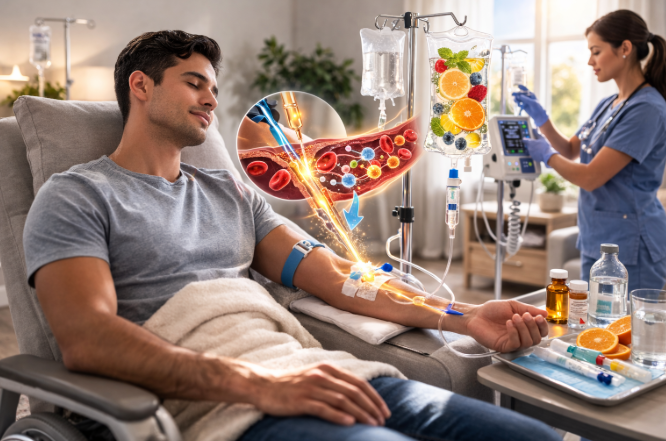 This fluid supports circulation and helps maintain plasma volume during infusion.
Hydration status influences cardiovascular function, blood pressure, and cellular activity. When fluids are delivered intravenously, they expand intravascular volume in a controlled manner. This can temporarily affect how nutrients are transported and utilized, particularly in individuals who were previously dehydrated.
Safety, Dosing, And Clinical Oversight
Delivering nutrients directly into the bloodstream requires attention to sterility, dosing accuracy, and patient assessment. Because absorption barriers are bypassed, inappropriate dosing can lead to rapid shifts in blood chemistry.
Clinical screening typically includes reviewing medical history, medications, allergies, and underlying conditions such as kidney or heart disease. Monitoring during infusion allows providers to observe for discomfort, vein irritation, or systemic reactions.
When administered under appropriate supervision, IV therapy follows established medical principles regarding fluid management and intravenous access.
When Intravenous Delivery May Be Considered
Intravenous nutrient therapy may be considered in situations where oral intake is limited, digestive absorption is impaired, or rapid correction of fluid or nutrient imbalance is needed. Examples include certain gastrointestinal disorders, recovery from acute illness, or periods of increased physiological stress.
It is not a replacement for a balanced diet or comprehensive medical care. Instead, it functions as a targeted delivery method within a broader health framework. The defining feature is not the nutrients themselves, but the direct route into systemic circulation.
